Get up to speed in just over minute with this audio summary…
A speedy listen, generated using Google Notebook LM.
The Human Capacity Cost of Tooling
The ideal toolset would allow the whole team to have the same deep knowledge, which they could effectively and consistently apply across all their data challenges. However, every piece of tooling competes for the same finite amount of time, attention, and expertise.
The more tools an organisation has the more fragile it becomes. This is due to:
- Reduced capacity. The more tools in play, the more thinly human capacity is spread and the harder it becomes to do anything well.
- Underutilised tools. Every tool added to the stack is another that will be partially understood, inconsistently applied, and underutilised.
- Complex support. Inconsistent tools are installed, configured, and maintained differently.
- Knowledge siloes. With multiple tools, it’s easy for expertise to concentrate in one person and when they leave, that knowledge leaves with them.
So how do you balance the need for tools and the capacity of your team?
The 10-Block Problem
A different way to look at the challenge is to consider your team’s collective operational capacity as 10 blocks. Every platform you add gets a share of those blocks. The more blocks a single platform holds, the deeper your team’s expertise in it.
With this in mind, how would you lay out your team’s attention?
Wide and Shallow or Narrow and Deep?
The ideal skill deployment is Narrow and Deep but new technologies are driving teams to Wide and Shallow model.
Wide and Shallow
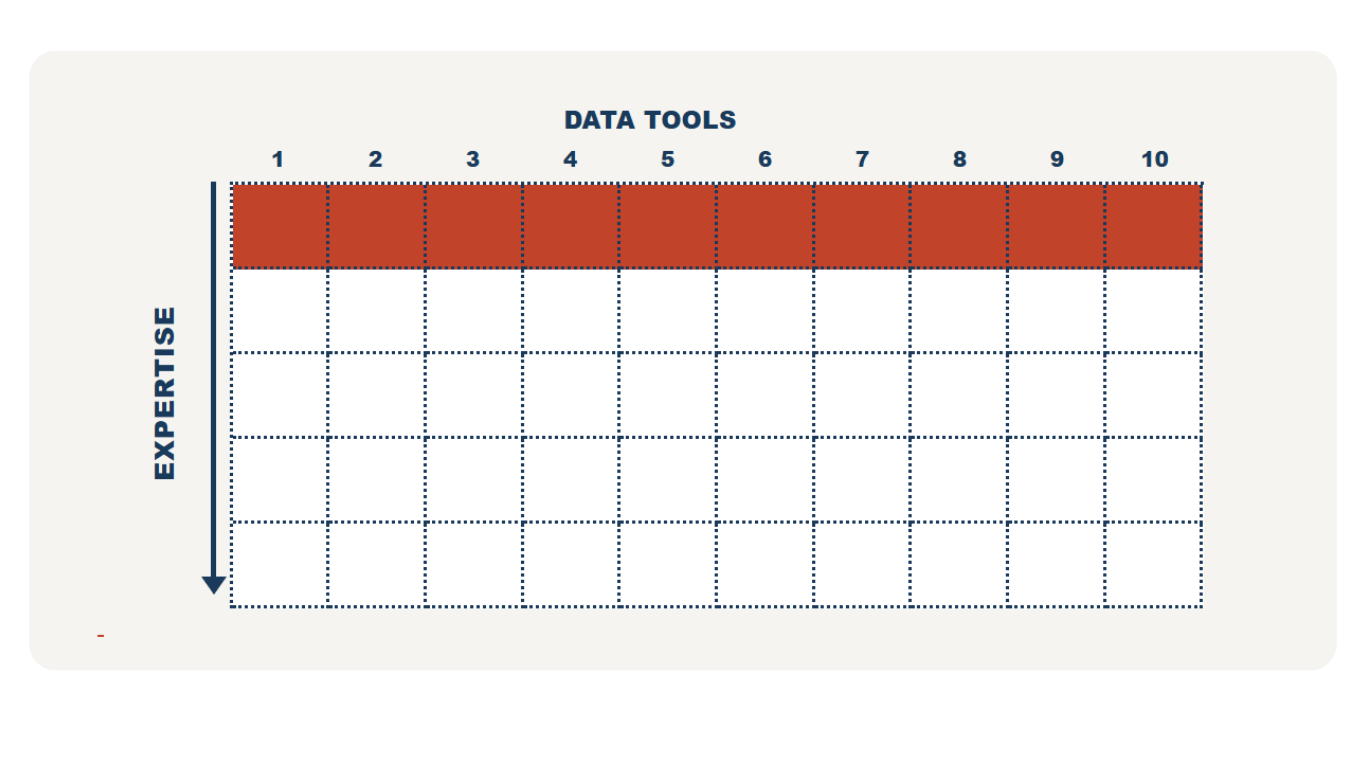 Wide and Shallow organisations spread capacity across a large number of platforms and services. On paper this makes sense, using the best tool for each job, but as teams are stretched across more tooling, expertise becomes spread thinly across platforms, making it harder to build real depth in any single capability. This is what creates genuinely fragile operations.
Narrow and Deep
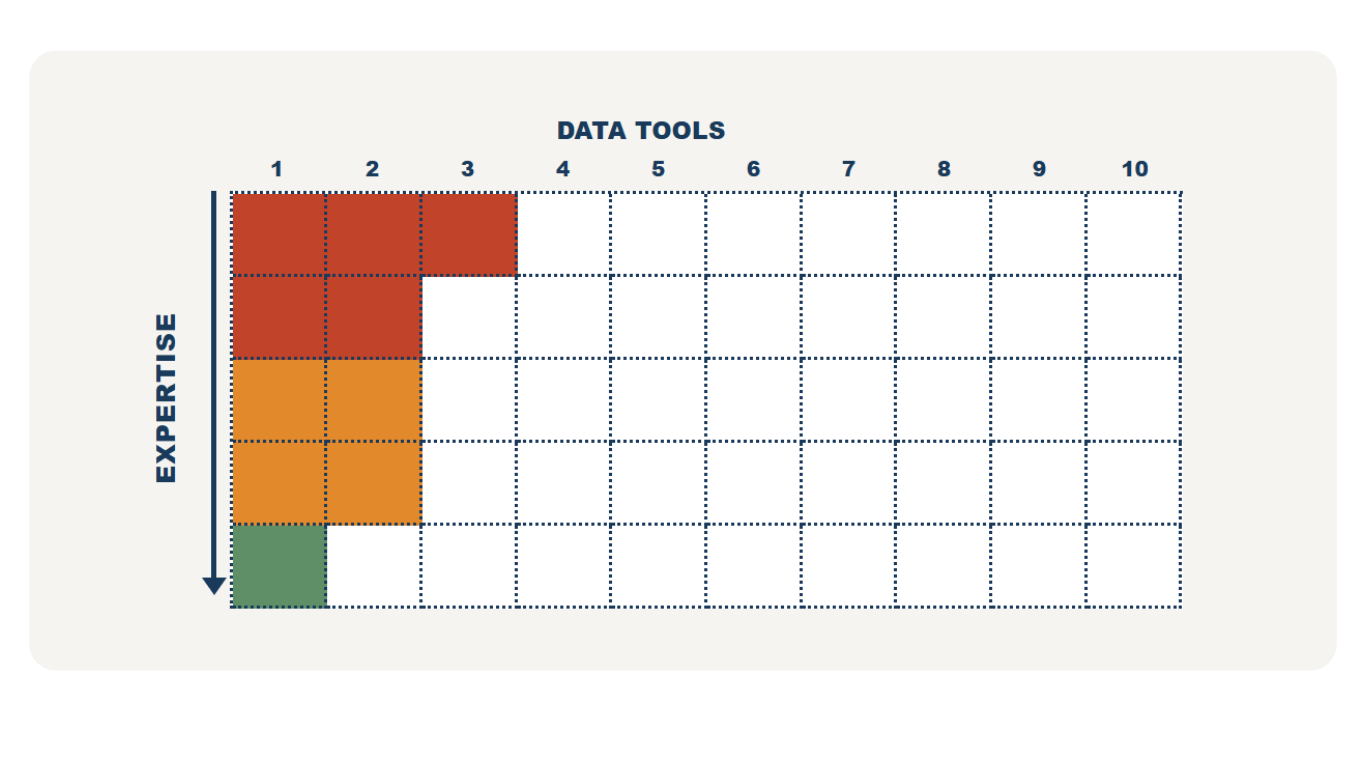
Narrow and Deep organisations deliberately standardise around fewer core platforms. Instead of adding tooling, they focus on building deeper operational capability. This creates stronger consistency across teams and processes, deeper expertise that compounds over time, and simpler support through shared knowledge.
The critical challenge of the narrow and deep model is choosing the right tools. The ones capable of replacing several point solutions and working across your environments and systems.
FME is built for depth
FME really excels in driving the Narrow and Deep model because it can be deployed in so many more environments and situations that most competing data management platforms.
FME’s truly environment agnostic approach, allows organisations to work across cloud, hybrid, and on-premises environments without constantly changing the data management platform used by their teams. The same logic, the same interface, and the same operational patterns apply regardless of where workloads run. That consistency helps organisations go deeper instead of endlessly wider. Skills transfer across projects, knowledge compounds, governance is consistent and teams are able to focus on what they need to deliver, not what they need to administer.
This doesn’t mean sacrificing specialist capability. FME’s flexibility means organisations can use specialist tools where they genuinely need them, because it supports a broad range of connections, systems, and file types.
Balancing tools with capability
The challenge modern organisations face is not access to technology. It’s balancing platform breadth with human capacity.
Too wide, and those organisations becomes fragile, stretched across so many platforms that none are understood deeply enough to depend on when it matters.
The organisations that navigate cloud complexity best won’t be the ones with the most tooling. They’ll be the one that use the fewest number of tools in the most impactful way.
Want to know more? Download our PDF…
Insightful, shareable, available here.
The Miso Arms
Cynthia, The Landlady of The Miso Arms, chats with an exhausted Hannah about why too many cloud data tools are stretching teams too thin, and why organisations need to stop going “wide and shallow” and start going “narrow and deep” instead.
Read more about Cloud...
Cloud Tool Spend Is Spiralling. Here’s How to Take Back Control.
Cloud was supposed to make cost simpler, but as we’ve developed hybrid infrastructures and incorporated more tools it’s become exponentially more difficult to manage.
Read MoreYour cloud estate is evolving. Your data tools need to evolve with it.
Your environment didn’t appear overnight. It evolved with every platform decision, every architecture review, and every workload that moved to the cloud. The problem is that most data tools were built for a specific moment in that journey.
Read More5 qualities that your cloud data tools need
If our environments are in flux, the tools underneath them need to cope with that and not become another constraint. So rather than choosing a tool for one environment, we should be looking for the qualities that let it keep working across many.
Read MoreData Sovereignty Has an Ownership Problem
We’ve focused heavily on control, and in doing so, we’re starting to lose sight of the ownership of our data.
Read MoreThe carpenter rarely buys a new hammer, and neither should your IT Team
Mastery comes from using the same tools often, not constantly switching between new ones. The pressure is on IT teams to do the opposite.
Read MoreWhat is Cloud 1.0, 2.0, and 3.0, and why does it need LESS technology?
Cloud has fundamentally changed how organisations store and process data. What we’re calling “cloud” isn’t just about location, it’s actually a set of operating models that shape cost structures, skill requirements, and how easily a business can adapt over time.
Read MoreThe Myth of the One-Way Cloud
If you still think of FME as a desktop tool, you’re already behind. The cloud-first features make deployment, scaling, and cost management easier, smarter, and more efficient.
Read More